Best Smart Devices for Utility Rooms (Water, Power & Safety Alerts) 2026
Utility rooms are where a lot of “quiet disasters” start: a water heater starts seeping, a condensate line backs up, humidity creeps up around equipment, or power trips and you don’t notice until something stops working. Because these spaces are rarely visited daily, the best approach is simple: install a few smart devices that alert you early—before damage spreads.
The picks below focus on the most common utility-room risks: water leaks, temperature/humidity drift, power loss, and overheating risk around equipment.
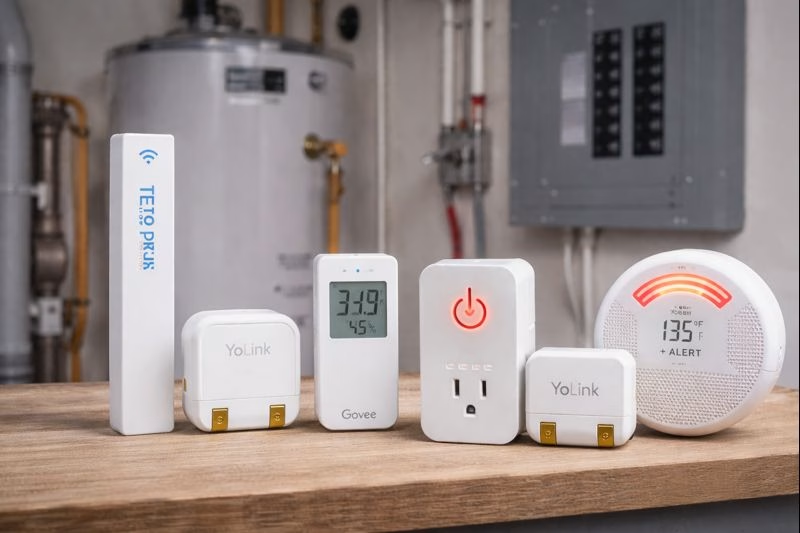
YOLINK WATER LEAK SENSOR (NO SUBSCRIPTION)
Best for Water Heater & Utility Sink Leak Alerts
In most homes, the highest-value place to deploy a leak sensor is the utility room. A small leak from a water heater, boiler feed line, or utility sink can go unnoticed for a long time—especially if the floor is unfinished or the area is cluttered. A leak sensor turns that slow problem into an immediate alert.
What to Know Before Setup: This is one of those devices where placement matters more than features. Put it at the first place water would show up: under the water heater’s drip edge, near the pressure relief valve discharge pipe, or directly beneath supply line connections.
Why We Chose This: It’s reliable, long-range friendly, and ideal for utility rooms where Wi-Fi can be inconsistent.
- Best for: water heaters, boilers, utility sinks, condensate areas
- Good fit if: you want fast leak alerts without complexity
- Helpful tip: If you have a floor drain, place a second sensor nearby—backups happen
TEMP STICK WI-FI TEMPERATURE & HUMIDITY SENSOR
Best for “Something’s Off” Temperature/Humidity Alerts
Utility rooms often signal trouble through environmental changes: humidity rises because a drain line is backing up, temperatures drop near pipes that run along exterior walls, or the room gets hotter than normal because ventilation is poor. Temp Stick is useful because it’s alert-driven—you can set thresholds and get notified when conditions drift into risk territory.
What to Know Before Setup: Don’t place it directly next to a boiler, water heater vent, or dehumidifier output. You want a reading that reflects the room’s overall conditions, not a hot/cold blast that can trigger false alarms.
Why We Chose This: It helps you catch the “early warning” stage—before moisture, freezing, or equipment strain becomes obvious.
- Best for: temperature drops, humidity drift, unmonitored utility spaces
- Good fit if: you want alerts instead of checking readings manually
- Helpful tip: Set humidity alerts slightly below “mold risk” so you can act early
GOVEE WI-FI TEMPERATURE & HUMIDITY SENSOR (H5179)
Best Budget Option for Multi-Spot Coverage
Some utility rooms have multiple “risk pockets”—one side near a water heater, another near an exterior wall where pipes run cold, and another near storage where airflow is poor. Govee is a practical way to add coverage without spending a lot, especially if you want to compare two corners of the same room and learn where your real problem area is.
What to Know Before Setup: Utility rooms can have big temperature gradients. If you place a sensor near an exterior wall, it may read dramatically colder than the center of the room—which is exactly what you want to know for freeze risk, but it can surprise people.
Why We Chose This: It’s an affordable way to expand monitoring and identify your “worst” zone.
- Best for: multi-sensor setups, cold corners, humidity hotspots
- Good fit if: you want to map the room’s risk areas
- Helpful tip: Put one sensor near the coldest wall and one near equipment—compare trends
YOLINK SMART POWER FAIL ALARM
Best Power-Loss Alert for Utility Equipment
Power loss can quietly disable key utility-room systems: a sump pump, dehumidifier, vent fan, boiler controls, or even the outlet powering smart sensors. A power fail alarm gives you immediate awareness that something went offline—often before the consequences show up elsewhere in the home.
What to Know Before Setup: The smartest placement is on the circuit that represents your “critical equipment.” If your dehumidifier, sump pump, or boiler outlet is on a specific circuit, plug it there so the alert maps to what you actually care about.
Why We Chose This: It’s one of the simplest devices that prevents a chain reaction of problems.
- Best for: sump pump circuits, dehumidifiers, utility outlets, second homes
- Good fit if: you want outage awareness without checking anything manually
- Helpful tip: Pair with a temp/humidity sensor so you see power loss and its impact
X-SENSE SMART HEAT ALARM XH02-M (BASE STATION REQUIRED)
Best Extra Layer for Overheat Risk Awareness
Utility rooms often contain equipment and electrical components that can run hot. A heat alarm isn’t a daily-use device—it’s more like an insurance layer. If something is overheating in a space you rarely check, you want a clear, attention-grabbing alert rather than discovering it late through smell, damage, or a failure.
What to Know Before Setup: This is not a replacement for code-required smoke alarms. It’s an additional monitoring layer for heat-risk awareness. Because it requires a base station, it’s best if you’re intentionally building a monitored safety setup rather than buying a one-off device.
Why We Chose This: Utility rooms are high-consequence spaces—adding a heat-risk alert can be a smart extra layer.
- Best for: utility rooms with electrical panels/equipment, older homes, rarely-visited basements
- Good fit if: you want an added safety signal beyond water + humidity
- Helpful tip: Place it away from direct heat vents so it reflects true room conditions
Utility Room Monitoring Placement Checklist
- Leak sensor: by the water heater base, supply lines, and floor drain areas
- Temp/humidity sensor: at “room level” away from direct vent blasts
- Power fail alarm: on the outlet/circuit powering critical utility equipment
- Heat alarm: in the room where overheating would be high consequence, away from vents
Disclosure: As an Amazon Associate, we earn from qualifying purchases.