Best Smart Devices for Sump Pumps (Water Level, Power & Failure Alerts) 2026
Sump pumps are one of those “you don’t think about it until it’s a disaster” systems. Most basement floods don’t happen because the pump never existed — they happen because the pump lost power, the water rose faster than expected, or the pump ran but didn’t actually move water.
The goal with a smart sump pump setup is simple: know there’s a problem before the water reaches your floor. The devices below focus on the real failure points: rising water level, power loss, and early warning signs that your basement is trending wetter than normal.
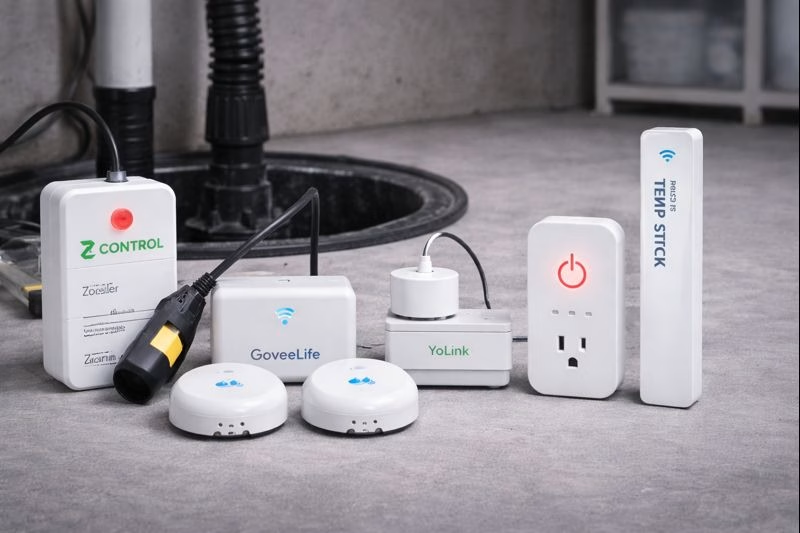
ZOELLER 10-4013 APAK Z CONTROL ENABLED INDOOR ALARM
Best Dedicated High-Water Alarm (Purpose-Built for Sump Pits)
This is the kind of product that exists for one reason: to alert you when water is higher than it should be. A dedicated sump alarm is often the most reliable first step because it doesn’t require you to “interpret” anything — if the water rises, it triggers. That directness is exactly what you want when the stakes are high.
What to Know Before Setup: The biggest setup mistake is placing the sensor too low (which can cause nuisance alerts) or too high (which alerts too late). You want it at a height that gives you time to act — before the pit overflows.
Why We Chose This: It’s a straightforward, purpose-built high-water alarm designed for sump situations, not a generic leak puck.
- Best for: sump pits, primary pumps, finished basements
- Good fit if: you want a simple “water is too high” alert without complexity
- Helpful tip: Test it once during a dry week so you trust it before storm season
GOVEELIFE PREMIUM SMART WATER LEAK DETECTOR 2 (GATEWAY + SENSORS)
Best Multi-Sensor Kit for Catching Water Where It Spreads
Sump problems rarely stay contained. Even if water starts at the pit, the damage often happens where it spreads — along the basement floor, toward storage, under finished walls, or into the utility area. A multi-sensor leak kit lets you cover several “first impact” zones so you get alerted as soon as water shows up where it shouldn’t.
What to Know Before Setup: Place sensors where water will arrive first, not where it will end up. That usually means the lowest points, the edges near the pit, and anywhere water would naturally run during overflow. If your basement has a slope, use it to your advantage.
Why We Chose This: It’s an easy way to add coverage beyond the pit without buying everything separately.
- Best for: finished basements, storage areas, utility rooms near the sump
- Good fit if: you want multiple coverage points with one setup
- Helpful tip: Put one sensor a few feet from the pit—water often reaches that zone before you notice
YOLINK WATER LEVEL MONITORING SENSOR STARTER KIT (FLOAT SWITCH + HUB)
Best for Early “Water Is Rising” Alerts (Long-Range Reliability)
If you want the most sump-specific smart alerting, water level monitoring is the move. Unlike a floor leak puck, a water level sensor can warn you that the pit water is rising abnormally — which often means the pump isn’t keeping up, the check valve is failing, or the discharge is blocked. This can give you a meaningful head start.
What to Know Before Setup: Most frustration with water level sensors comes down to mounting. The float needs to be installed securely at the right height so it triggers early enough to matter, but not so early that normal pump cycling causes nuisance alerts.
Why We Chose This: It’s a true “sump pit health” signal, and YoLink’s long-range approach is very basement-friendly.
- Best for: sump pits, heavy rain areas, basements with a history of backups
- Good fit if: you want to know when the pit is rising before it overflows
- Helpful tip: Set alerts at a “warning” height that still gives you time to call for help
YOLINK SMART POWER FAIL ALARM
Best “Pump Lost Power” Alert
The most common sump pump failure is painfully simple: it loses power. A brief outage, a tripped breaker, a loose plug — and suddenly your pump isn’t protecting you at all. A power fail alarm closes that gap by notifying you when the outlet loses power and when it returns.
What to Know Before Setup: Plug this into the same outlet/circuit as your pump (or the outlet that represents that circuit). If the pump is hardwired, use a nearby outlet on the same circuit if possible so the alert maps to the pump’s real power status.
Why We Chose This: Knowing about power loss is often the difference between “close call” and “flooded basement.”
- Best for: sump pump outlets, basement utility circuits, second homes
- Good fit if: you want immediate outage awareness
- Helpful tip: Pair with a water level sensor for “cause + impact” coverage
TEMP STICK WI-FI TEMPERATURE & HUMIDITY SENSOR
Best “Basement Trending Wet” Early Warning
Not every sump problem is sudden. Sometimes the warning sign is that your basement is slowly staying wetter than normal — humidity creeping up after storms, lingering dampness, or a musty smell returning. A temperature/humidity sensor gives you that higher-level signal so you can respond early (dehumidifier adjustments, drainage checks, pump inspection) before the next big rainfall stress-test.
What to Know Before Setup: Don’t put this right next to a dehumidifier or vent. You want a representative reading of the basement air, ideally in the zone that tends to feel dampest.
Why We Chose This: It gives trend-level context that complements sump-specific alerts — and helps you catch “wet basement” patterns early.
- Best for: finished basements, damp basements, storm-prone regions
- Good fit if: you want early warning signs, not just emergency alerts
- Helpful tip: Track humidity before and after storms—your baseline matters
Where to Place These Devices (Quick Sump Setup)
- High-water alarm / float sensor: mounted in the sump pit at a warning height (not the overflow height)
- Leak sensors: around the pit perimeter and at the lowest nearby floor points
- Power fail alarm: on the pump outlet/circuit so it reflects pump power status
- Humidity sensor: in the dampest basement zone (away from dehumidifier airflow)
Disclosure: As an Amazon Associate, we earn from qualifying purchases.