Best Smart Devices for Attics (Temperature, Moisture & Risk Alerts) 2026
Attics are the definition of “out of sight, out of mind” — which is exactly why small problems become expensive ones up there. Heat builds quickly in summer, moisture can quietly lead to mold or roof-deck damage, and you usually don’t notice anything until there’s a stain on the ceiling or an HVAC issue. A few smart devices can turn your attic into a monitored space with early warnings instead of surprises.
The picks below focus on the risks that actually matter in attics: extreme temperature swings, lingering humidity/condensation, and alerting you when conditions drift into a range worth addressing.
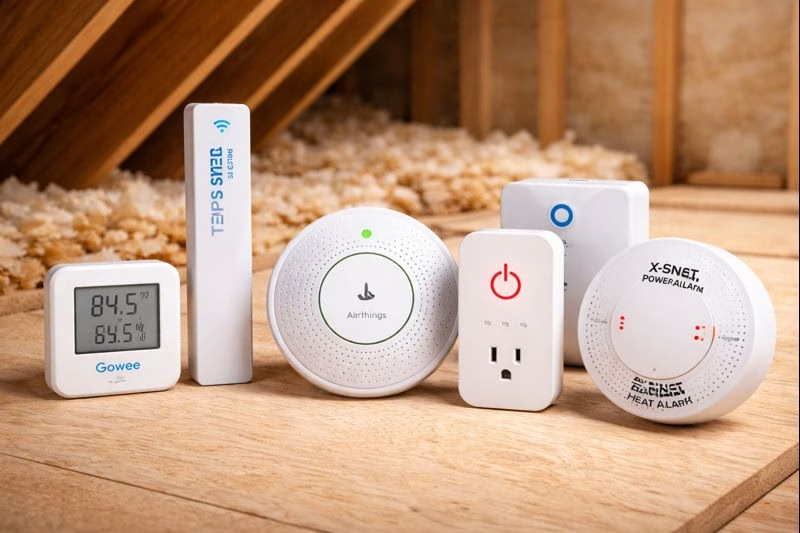
GOVEE WI-FI TEMPERATURE & HUMIDITY SENSOR (H5179)
Best Budget Attic Monitor for Heat + Humidity Trends
If you want a simple, affordable way to see what your attic is doing day-to-day, Govee is a great starting point. It helps you catch the basics quickly: how hot the attic gets in peak summer, whether humidity stays elevated after rain, and whether conditions spike when your HVAC runs.
What to Know Before Setup: Don’t mount this right against the roof deck or directly above insulation where temperatures can read more extreme than the attic air. You want a representative reading—typically a rafter or framing member a bit away from direct roof contact.
Why We Chose This: It’s a low-friction way to get immediate clarity on attic heat and humidity patterns.
- Best for: basic attic monitoring, finished attics, occasional checks
- Good fit if: you want data without a big setup
- Helpful tip: Track one full heat wave—those peaks tell you the real story
TEMP STICK WI-FI TEMPERATURE & HUMIDITY SENSOR
Best for Remote Alerts When Attic Conditions Drift
Temp Stick is ideal if you want more than “interesting readings” — you want a notification when attic conditions move into a range that could cause damage. That might be humidity staying high long enough to support condensation, or temperatures spiking beyond what you expect (which can impact HVAC efficiency and even roof lifespan over time).
What to Know Before Setup: Wi-Fi in attics can be unreliable if your router is far away. If alerts are inconsistent, you may need a mesh node on the top floor or in a hallway near the attic access. A tiny Wi-Fi improvement can make the whole system feel dependable.
Why We Chose This: Threshold alerts are exactly what makes attic monitoring useful—otherwise it’s easy to ignore the data.
- Best for: second homes, attics you rarely check, HVAC-adjacent attics
- Good fit if: you want “tell me when it matters” monitoring
- Helpful tip: Set a humidity alert that’s early enough to act, not just confirm a problem
AIRTHINGS 2930 WAVE PLUS (RADON & AIR QUALITY MONITOR)
Best for Air Quality + Ventilation Awareness in Finished Attics
If your attic is finished (or used as an office, bedroom, or playroom), air quality becomes part of the equation. Stale air and trapped VOCs can build up in upper levels, and in some homes radon concerns aren’t limited to basements. Wave Plus can add another layer of visibility beyond temperature and humidity, helping you decide if ventilation or air exchange needs improvement.
What to Know Before Setup: This is most valuable in occupied attic spaces. In an unconditioned attic you rarely enter, temperature/humidity monitoring usually matters more than air-quality data.
Why We Chose This: For finished attics, it rounds out monitoring with air-quality factors that affect comfort and long-term use.
- Best for: finished attics, attic offices/bedrooms, upper-level comfort tuning
- Good fit if: the attic feels stuffy or you want ventilation insight
- Helpful tip: Place it where people spend time, not tucked behind stored items
YOLINK SMART POWER FAIL ALARM
Best “Something Lost Power” Alert for Attic Fans/Dehumidifiers
Many attics rely on powered systems to stay healthy—vent fans, dehumidifiers, or HVAC components nearby. If power fails or a breaker trips, those systems stop working, and attic conditions can drift into problem territory quickly. A power fail alarm gives you immediate awareness that something went offline.
What to Know Before Setup: Plug this into the outlet or circuit that powers what you care about (fan, dehumidifier, etc.). The alert only helps if it reflects the real point of failure you want to know about.
Why We Chose This: It’s a simple way to learn about power loss before heat/moisture problems compound.
- Best for: attic fans, dehumidifiers, HVAC-adjacent outlets
- Good fit if: you want outage awareness for attic equipment
- Helpful tip: Combine with a temp/humidity sensor for “power loss + impact” coverage
X-SENSE SMART HEAT ALARM XH02-M (BASE STATION REQUIRED)
Best Heat-Risk Alert for Attics
Attics can get brutally hot, and in rare cases overheating can become a safety concern—especially near older wiring or poorly ventilated spaces. A heat alarm is a different kind of monitoring: it’s not about comfort or humidity, it’s about being alerted if heat reaches levels that warrant immediate attention.
What to Know Before Setup: This is not a replacement for a standard smoke alarm where code requires one. It’s a complementary device meant to provide additional warning in hot spaces. Since it requires a base station, it makes the most sense if you’re building a monitored safety setup (not just adding one standalone sensor).
Why We Chose This: It supports the “risk alert” side of attic monitoring and adds a safety-oriented signal beyond climate data.
- Best for: hot attics, older homes, attics with electrical runs or equipment areas
- Good fit if: you want an added layer of heat-risk alerting
- Helpful tip: Place it near the hottest zone but away from direct roof contact for more consistent readings
Where to Place Attic Monitoring Devices (Quick Checklist)
- Temp/humidity sensors: mounted to framing away from direct roof deck contact
- Finished attic air monitor: in the occupied zone (where you actually breathe/use the space)
- Power fail alarm: on the outlet powering attic fans/dehumidifiers (or relevant circuit)
- Heat alarm: near the hottest zone, but not in direct sun/roof contact areas
Disclosure: As an Amazon Associate, we earn from qualifying purchases.