Best Smart Devices for Crawl Spaces (Moisture, Mold & Airflow Alerts) 2026
Crawl spaces are one of the most overlooked parts of a home—until there’s a musty smell, warped floors, or an inspection report that suddenly makes it everyone’s top priority. The tricky part is that crawl space issues usually start quietly: humidity stays high, condensation forms, standing water appears after storms, or a dehumidifier loses power and nobody notices.
The right smart devices won’t “fix” a crawl space, but they will give you early warning so you can act before moisture turns into mold, rot, or expensive remediation. The products below focus on the signals that matter most: humidity trends, water presence, air quality context, and power loss for crawl-space equipment.
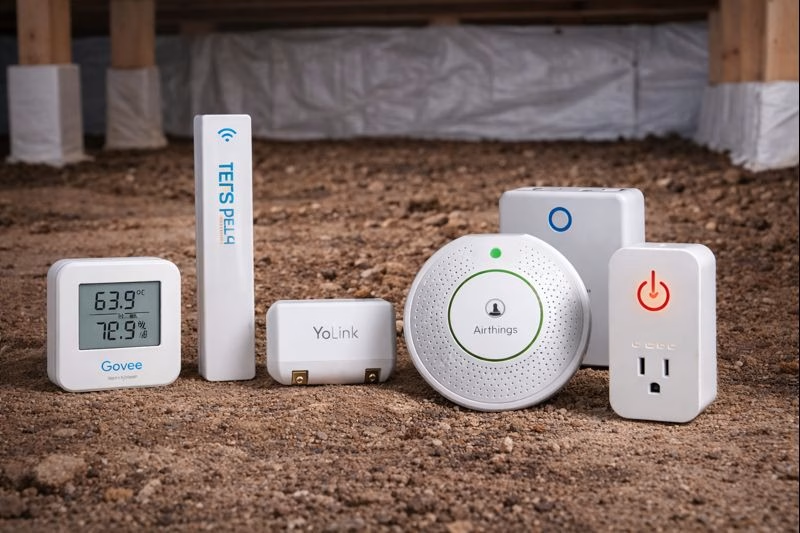
GOVEE WI-FI TEMPERATURE & HUMIDITY SENSOR (H5179)
Best Budget Crawl Space Humidity Monitor
If you want a simple, affordable way to know whether your crawl space is trending too humid, Govee is an easy starting point. It helps you stop guessing—especially after rainstorms or seasonal shifts—so you can see whether moisture is a one-off event or a persistent pattern.
What to Know Before Setup: Crawl spaces can have microclimates. If you place one sensor near the access door, it may not reflect the dampest section. If possible, place it closer to the area that historically smells musty or feels damp (often the farthest corner or the lowest point).
Why We Chose This: It’s low cost, low friction, and gives quick clarity on whether you have a real humidity problem.
- Best for: basic humidity tracking, seasonal monitoring
- Good fit if: you want data without investing heavily up front
- Helpful tip: Check readings 24–48 hours after heavy rain—that’s when issues show up
TEMP STICK WI-FI TEMPERATURE & HUMIDITY SENSOR
Best for Alerts When Crawl Space Conditions Drift
Temp Stick is a good choice when you want proactive alerts—not just numbers. For crawl spaces, that typically means getting notified when humidity stays too high for too long, or when temperatures swing into a range that can cause condensation on pipes or framing.
What to Know Before Setup: Crawl spaces can be tough for Wi-Fi. If the sensor struggles, it’s usually not the device—it’s the signal. A mesh node on the floor above (near the crawl space access point) can dramatically improve reliability without major effort.
Why We Chose This: Crawl spaces need alerts more than dashboards—you’re rarely checking readings daily.
- Best for: second homes, “set it and forget it” monitoring
- Good fit if: you want warnings before mold-prone humidity persists
- Helpful tip: Set a conservative humidity alert so you catch problems early
YOLINK WATER LEAK SENSOR (NO SUBSCRIPTION)
Best for Standing Water & “Something Is Wet” Alerts
Sometimes the crawl space problem isn’t humidity—it’s actual water. A leak sensor is a simple way to get alerted if water starts pooling where it shouldn’t. That can happen from groundwater seepage, plumbing leaks, or water intrusion after storms.
What to Know Before Setup: Placement is everything. Put it at the crawl space’s lowest point, near plumbing penetrations, or wherever water historically collects. A leak sensor placed in a “clean” area won’t help you when water shows up elsewhere.
Why We Chose This: It’s a reliable “first sign of water” alert, and YoLink’s range tends to perform well in difficult environments.
- Best for: low points, near plumbing, areas prone to pooling
- Good fit if: you’ve ever had water intrusion after heavy rain
- Helpful tip: If you have multiple low spots, consider more than one sensor
AIRTHINGS 2930 WAVE PLUS (RADON & AIR QUALITY MONITOR)
Best for Air Quality Context (Especially in Radon Areas)
In many homes, the crawl space contributes to indoor air quality—especially when air moves upward into living areas. If you’re in a radon-prone region or you’ve had musty air concerns, an air quality monitor can add useful context beyond humidity alone. It can also help you understand whether ventilation improvements are making a difference over time.
What to Know Before Setup: This is most valuable if your crawl space is vented into the home (intentionally or not) or if you’re actively trying to manage radon/air concerns. If you’re only focused on water and humidity, start with the sensors above first.
Why We Chose This: It adds a different layer of insight—air quality and radon context—beyond moisture alone.
- Best for: radon-aware homeowners, air quality concerns, long-term monitoring
- Good fit if: you’re improving encapsulation/ventilation and want measurable feedback
- Helpful tip: Place it where air actually circulates, not buried behind stored items
YOLINK SMART POWER FAIL ALARM
Best Power-Loss Alert for Crawl Space Dehumidifiers/Fans
If your crawl space relies on a dehumidifier, fan, or pump, power loss can quietly undo your progress. A power fail alarm alerts you when the outlet loses power and when it comes back—so you’re not assuming equipment is running when it isn’t.
What to Know Before Setup: Plug it into the same outlet/circuit as the device you care about. If the dehumidifier trips a breaker and the alarm is on a different circuit, you won’t get the warning you need.
Why We Chose This: It’s a simple “are my crawl space systems still running?” check that you don’t have to remember to do manually.
- Best for: crawl space dehumidifiers, vent fans, pumps
- Good fit if: you depend on equipment to manage moisture
- Helpful tip: Pair with humidity alerts so you see both the outage and the impact
Crawl Space Monitoring Placement Checklist
- Humidity sensor: in the dampest zone (often the farthest/lowest corner), not near the access door
- Leak sensor: at the lowest point or near plumbing penetrations where water appears first
- Air monitor: where air circulates (useful if air quality/radon is a goal)
- Power fail alarm: on the same outlet/circuit as your crawl space dehumidifier or fan
Disclosure: As an Amazon Associate, we earn from qualifying purchases.