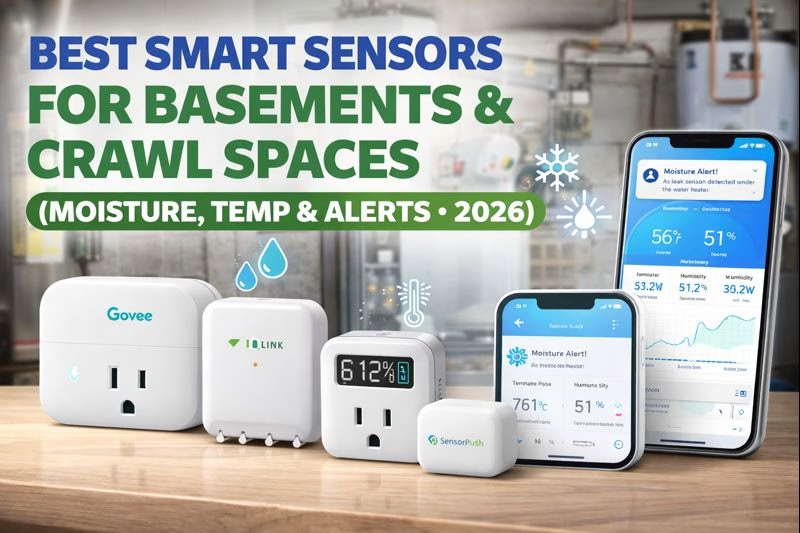
Best Smart Sensors for Basements & Crawl Spaces (Moisture, Temp & Alerts) – 2026
Basements and crawl spaces are where small problems quietly turn into expensive ones: a slow leak behind a boiler, a sump pump issue, winter freeze risk, or humidity creeping up until you smell that musty “uh oh.” The right smart sensors catch those issues early—before you see stains, warped floors, or mold. The goal isn’t more tech; it’s early warning + fast action.
Related:
Leak Detectors |
Smart Dehumidifiers |
Wi-Fi Range Extenders |
Smart Water Shut-Off Valves
GOVEE WIFI WATER LEAK DETECTOR (GATEWAY + SENSORS)
Best “Cover the Whole Basement” Leak Alert System
This is the easiest way to build a practical water-protection net: place sensors by the water heater, boiler, washing machine, sump area, and any suspicious corner where moisture shows up. The big value is remote alerts—so you’re not relying on being home to hear an alarm.
- Who it’s for: Anyone who wants multi-room coverage with minimal setup.
- Why it’s worth it: Great for spreading sensors across common “risk zones” in basements and utility rooms.
- Real-world tip: Put one sensor near the sump pit and one directly under the water heater/boiler connections—those are frequent failure points.
YOLINK WATER LEAK SENSOR (3-PACK)
Best Long-Range Choice for Tricky Crawl Spaces
Crawl spaces are notorious for weak Wi-Fi. YoLink’s advantage is its long-range approach, which can be a lifesaver when your router is two floors away and signal drops are common. It’s a strong fit for “set it and forget it” leak detection where you mainly care that the alert gets out reliably.
- Who it’s for: Homes where Wi-Fi doesn’t reliably reach the basement/crawl space.
- Why it’s worth it: Better odds your alert actually reaches you when you need it.
- Real-world tip: Use one under the main shutoff area and one near any foundation wall where seepage historically appears.
YOLINK TEMPERATURE & HUMIDITY SENSOR
Best for Freeze Risk + Basement Humidity Tracking
Water sensors catch active leaks. Temperature/humidity sensors catch the slow-burn issues: pipes near freezing, humidity creeping up, or a dehumidifier that isn’t keeping up anymore. This is the sensor you use to answer, “Is my basement actually stable… or just usually fine?”
- Who it’s for: Basements with plumbing on exterior walls, older homes, or spaces that swing seasonally.
- Why it’s worth it: Alerts you before you get condensation, mold smell, or a winter freeze surprise.
- Real-world tip: Place it where the risk is highest (near the coldest corner), not where it’s most convenient.
GOVEELIFE WIFI HYGROMETER THERMOMETER (H5179)
Best for Simple Remote Checks (Great “Normal Home” Option)
This is a great pick when you want a clean app experience and the ability to quickly check basement humidity from your phone. It’s especially useful if your goal is to keep humidity in a safe range (many people target ~40–55% RH) and spot trends—like “humidity spikes every time it rains.”
- Who it’s for: Homeowners who want easy monitoring without overthinking it.
- Why it’s worth it: Practical remote visibility into humidity and temperature—perfect for basements.
- Real-world tip: Use it to validate your dehumidifier: if humidity isn’t dropping, you may need drainage, placement, or capacity changes.
SENSORPUSH HT1 TEMPERATURE & HUMIDITY SENSOR
Best “Accuracy + History” Pick for Serious Monitoring
SensorPush is for the person who wants trustworthy readings and useful history. If you’ve ever tried to debug a musty smell, intermittent condensation, or “why is this corner always damp?”, having clean temperature/humidity history helps you connect cause and effect—weather changes, HVAC behavior, or dehumidifier cycles.
- Who it’s for: Anyone who wants to track trends and diagnose problems, not just get alerts.
- Why it’s worth it: Excellent for understanding humidity patterns over time (which is usually what drives basement issues).
- Real-world tip: Put one in the basement and one on the main floor—comparing them can reveal whether the basement is driving the home’s overall comfort issues.
Quick Setup Checklist (Where to Place Sensors)
- Water heater / boiler: under fittings + near the relief valve discharge area.
- Sump pit: near the rim or floor adjacent to the pit (not inside the pit).
- Washer / utility sink: behind the machine where hose leaks start.
- Cold corners: one temp sensor in the coldest spot to catch freeze risk early.
- Humidity reality check: place a hygrometer near the center of the basement, not right next to the dehumidifier.
More helpful guides:
Leak Detectors |
Smart Dehumidifiers |
Smart Water Shut-Off Valves
Disclosure: As an Amazon Associate, we earn from qualifying purchases.